01
Function map
Describe each service in verbs before applying a label.
Open reference →Independent decentralized VASP reference
dVASP.com is a function-first field guide for understanding virtual-asset services across protocols, interfaces, entities, DAOs, wallets, and regulated operations.
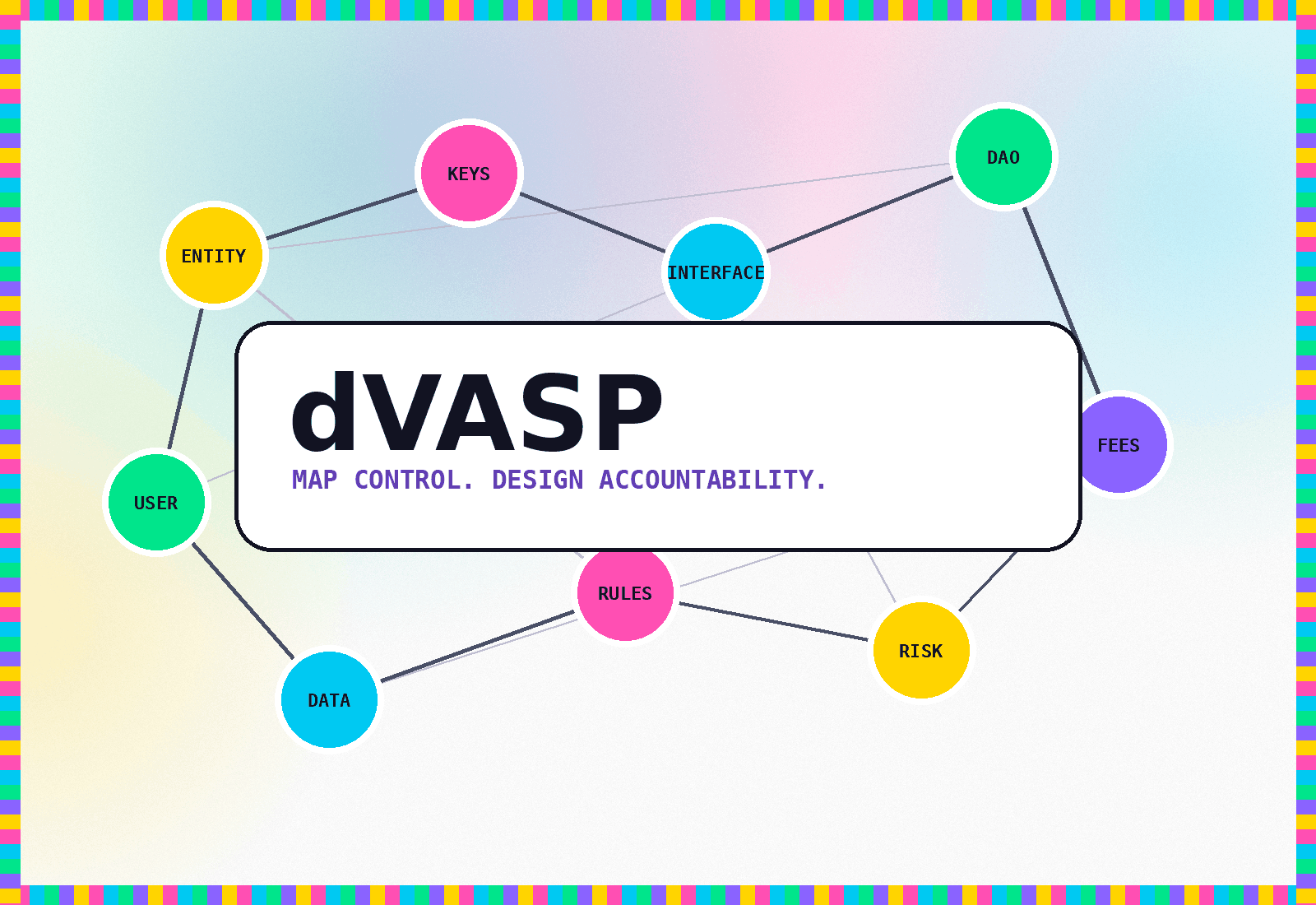
The function-first method
Move from product facts to control, risk, architecture, and jurisdiction—without assuming that “decentralized,” “software,” or “non-custodial” ends the analysis.
Describe each service in verbs before applying a label.
Open reference →Trace keys, interfaces, governance, fees, and practical influence.
Open reference →Connect customer, geography, asset, product, and transaction risk.
Open reference →Design data, counterparty, message, exception, and privacy workflows.
Open reference →Use accurate enforcement points, resilient data, and incident playbooks.
Open reference →Separate global standards from binding jurisdiction-specific law.
Open reference →A repeatable review path
Map user journeys, asset movement, counterparties, fees, and the service performed for others.
Trace entities, administrators, keys, interfaces, governance, operational dependencies, and practical influence.
Assess customers, assets, geographies, transactions, and the binding rules for each operating entity.
Connect policy to real technical enforcement points, exception states, secure operations, and reproducible records.
The central question
Control is layered. Smart contracts, front ends, governance, commercial arrangements, operations, and communications can have different owners and different consequences.
Latest field notes

Build compliance into a decentralized virtual-asset product through modular services, explicit decision points, strong evidence, and controlled change.
Read guide →
Understand why VASP and CASP are not interchangeable labels and how to build a service-by-service EU perimeter map.
Read guide →
Build a risk-based workflow for deposits and withdrawals involving self-hosted wallets, smart contracts, and uncertain counterparties.
Read guide →Frequently asked questions
No. dVASP is a practical shorthand used by this site for examining decentralized virtual-asset service models. Legal classifications depend on the functions performed, the people and entities involved, control, location, and applicable law.
No single architecture label decides the outcome. Non-custody is an important fact, but reviewers may also examine exchange, transfer, arrangement, interface, administrative, commercial, and governance functions.
At minimum: smart-contract permissions, interfaces, keys, governance, fees, entities, service providers, infrastructure, user relationships, incident powers, and evidence of how decisions are made.
No. It is an independent educational reference. Use qualified legal, compliance, security, and tax professionals for decisions about a particular product or jurisdiction.
Controls depend on secure data, credentials, releases, vendors, logs, and incident response. A compliance rule cannot be effective if the system that enforces or records it is unreliable.